
Resources · Search
AI search optimization small business owners can actually use
Written and reviewed by Andrei Yakushyk, founder of Suburban Webworks, Grafton, WI. 15 years building websites for marketing teams. Reviewed October 2026.
This is a guide to AI search optimization small business owners can act on without a new budget line. Tools like Google's AI Overviews, ChatGPT search and Perplexity now answer questions that used to send people straight to websites. The good news is that most of what helps you there is the same work that helps you in ordinary search.
I'll skip the predictions. Here's what has changed, what hasn't, and six things worth doing this quarter.
What is AI search?
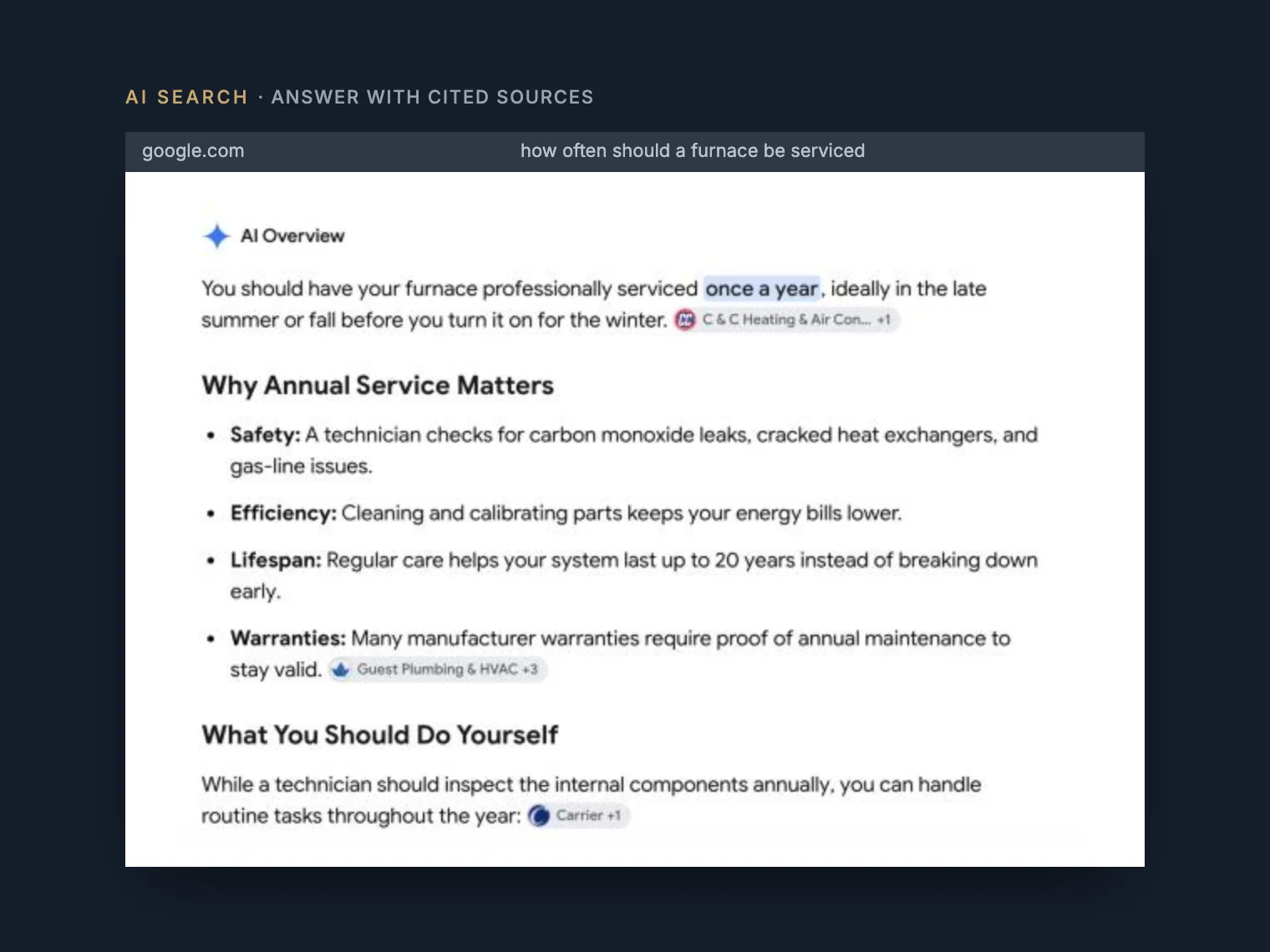
AI search is when a tool writes an answer to a question instead of only listing links. Google's AI Overviews and AI Mode, ChatGPT search, Perplexity and Microsoft Copilot all do this. Most of them show the websites they drew on as links beside the answer.
For a local business, a typical question is "Who builds websites near Cedarburg?" Another is "What does an HVAC tune-up cost in Ozaukee County?"
The tool reads the web, picks sources it trusts, and writes a short answer.
Does AI search change SEO?
Less than the headlines suggest. Google puts it plainly.
"There are no additional requirements to appear in AI Overviews or AI Mode, nor other special optimizations necessary."
The same basics that help you rank also make you eligible to be cited.
That quote comes from Google's own guidance, AI features and your website. It also says you don't need special structured data or new "AI text files" to appear. A page simply has to be indexed and eligible to show in Google with a snippet.
What has changed is the bar for clarity. An AI answer pulls a sentence or two from your page. If your page never says plainly what you do, where and for whom, there's nothing clean to pull.
Is AI search optimization worth it for a small business?
Yes, if you treat it as good search and messaging work, not a separate product. Be wary of anyone selling a special AI package with guaranteed mentions. No one controls what these tools say.
Here's the honest picture. Nobody outside Google or OpenAI can see exactly how sources are chosen. Anyone who promises you'll be named in ChatGPT is guessing. What you can control is whether your website, your Google Business Profile and your reviews give these tools clear, accurate material to work with.
Six steps for AI search optimization
1. Say what you do in the first two lines
Every important page should open with a plain statement: what you do, for whom, and where. "Residential and commercial HVAC repair in Grafton and Ozaukee County" is something an AI tool can quote. "Comfort you can count on" is not.
This is messaging work before it's search work. It's why my projects start with a brand messaging workshop.
2. Answer real questions, with the answer first
Write down the questions customers ask on the phone. Put each one on your site as a heading. Answer it in two or three sentences directly underneath, then add detail.
This article uses the same format. It helps readers who skim, and it gives AI tools a clean answer to cite.
3. Keep your Google Business Profile complete and current
Google's guidance tells site owners to keep Business Profile information up to date. For a local business, that profile often matters as much as the website. Check your categories, hours, service area, phone number and photos.
Use the same business name, phone number and town on your website, your profile and every directory listing. Inconsistent details make it harder for any tool to trust which version is right.
4. Earn reviews that describe the work
Reviews are public, specific and written in customers' own words. That makes them useful material for AI answers about local businesses. Ask happy clients for a Google review, and suggest they mention the job and the town.
You can't write the reviews, and you shouldn't try. You can make asking a normal part of finishing every job.
5. Make sure the tools can read your site
A few technical checks matter here:
- Keep important content in text. Words inside images or PDFs are harder for any tool to read.
- Don't block search crawlers by accident. Google says to keep crawling allowed in robots.txt and in any hosting or CDN settings.
- Allow ChatGPT's search crawler if you want to appear there. OpenAI's crawler documentation says sites that block OAI-SearchBot won't be shown in ChatGPT search answers.
- Verify your site in Google Search Console. It shows indexing problems you can't see from the outside.
- Make sure structured data matches the page. Google recommends that any schema reflect the visible text.
OpenAI runs a separate crawler, GPTBot, for training its models. You can block that one and still allow the search crawler. It's a business decision, not a technical requirement.
6. Publish proof, not volume
Writing dozens of short AI-generated posts won't help. Pages that show real experience will: a case study with the client's own words, a clear price range, an honest answer to a common question. One useful page beats ten thin ones.
What should a small business stop doing?
Stop buying tactics that promise rankings or AI mentions on a schedule. Stop publishing near-duplicate articles about the same topic. Stop paying for tools you don't have time to use. Put the money into clear pages and steady upkeep instead.
I cleaned up this kind of duplication on my own site. Three overlapping posts about AI search became this one article.
How do I know if AI search is sending me customers?
Some AI tools pass visitors through as referral traffic, which you can see in Google Analytics. Others leave no trail. The most reliable check is simple: ask every new caller how they found you, and write it down.
You can also run the test yourself. Ask ChatGPT, Perplexity and Google a question your best customer would ask, such as "Who does furnace repair near Mequon?"
Note who gets named and which pages get cited. Repeat it every quarter.
Where AI search fits in your marketing
AI search is one more place buyers look before they call you. It doesn't replace your website, your reviews or your reputation. It rewards the businesses that already explain themselves clearly.
If you want help with the local side, my local SEO and Google Ads work covers Google Business Profile upkeep, local search and listings. If you'd rather have one person own the whole plan, that's what a fractional CMO does. Each quarter we review what moved, including search, and pick the next steps.
Start with a review of your site
Want to know how your website reads to search tools and to buyers? I'll review your site and two or three competitors, then send written recommendations within 2 business days. It's free, and there's no obligation.
Or call me at (262) 382-0182. I'm based in Grafton, WI, serving businesses within 50 miles.